Blog
Insights
Why 78% of 70,000 Candidates Chose an AI Interview
Why 78% of 70,000 Candidates Chose an AI Interview (And What It Teaches Us About Human Hiring)

Allen Turner
VP, Revenue
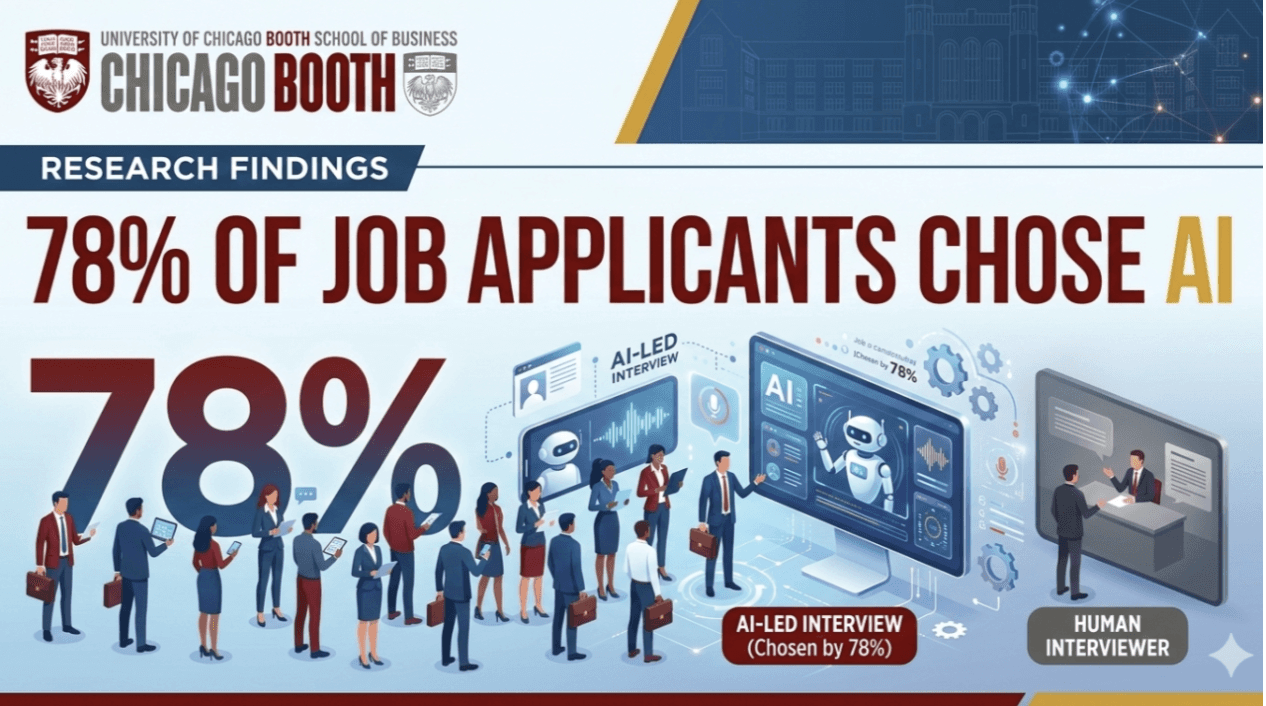
Most people assume that AI in hiring is about replacing human judgment. But a massive new study suggests something else entirely: AI’s greatest value isn't replacing human judgment—it’s replacing human inconsistency.
In a rare, large-scale randomized field experiment (working paper; last revised Jan 26, 2026), researchers from Chicago Booth and Erasmus University studied over 70,000 job applicants. The results offer a blueprint for the future of recruitment.
When given a direct choice between a human recruiter and an AI voice agent—a natural-language system that conducts a phone conversation much like a human—78% of candidates chose the AI.
Here is what we can learn from the data.
1. The Performance Delta
The study focused on high-volume, entry-level roles (customer service and call-center style work) in the Philippines. By randomly assigning candidates to human recruiters or AI voice agents, the researchers found that AI-led screening significantly improved the "quality of hire":
12% Lift in Offers: Candidates interviewed by AI were roughly 12% more likely to receive job offers (with offer rates rising from approximately 8.70% to 9.73%).
The Retention Signal: AI-interviewed candidates were 18% more likely to start the job and 18% more likely to remain employed after 30 days. This durability signal persisted for up to four months.
No Productivity Drop: Despite the automated screening, hired workers showed no decline in core performance metrics like CSAT (customer satisfaction) or average handle time.
2. The Mechanism: “Controlled Variance”
Why did a machine outperform experienced recruiters at the screening stage? The authors point to a concept called “Controlled Variance.”
Human recruiters—even those following a script—suffer from "noise." They get tired, they have "gut feels," and they vary their questions or tone based on the candidate. This creates a "Recruiter Lottery" where a candidate's success depends on who they talk to.
The AI, however, provides a highly structured and consistent framework while remaining responsive to individual answers. By standardizing the information collection, the AI provided human decision-makers with richer, more comparable data to evaluate.
3. Reducing the "Friction" of Bias
The study also touched on a critical human element: reported discrimination. Candidates in the AI-led group reported significantly lower levels of perceived gender-based discrimination during their interview experience—falling from 5.98% to 3.30%. Candidates chose AI because they felt they would get a "fairer shake" without the subtle micro-judgments that can occur in a human-to-human call.
4. Important Nuance: It’s Not Magic
While these results are compelling, implementation quality matters. The researchers noted that ~7% of AI-led interviews faced technical difficulties. Furthermore, this study focused on high-volume roles where standardized criteria are easier to define; results may differ for executive or highly creative roles.
Crucially, humans still made the final hiring decisions. The AI didn't hire the person; it simply provided a more consistent "first-mile" screen.
The AceUnlock Perspective: Protecting Human Judgment
At AceUnlock, we believe this study validates the next era of recruitment. The goal isn't to remove the human; it's to protect the human.
When recruiters are forced to run 25 repetitive first-round screens a week, they lose the energy and nuance required for high-level evaluation. By using AI for consistency in the "first-mile" screen, we empower recruiters to focus their judgment where it actually matters: the final interview and the offer close.
The takeaway for hiring teams: Stop using your most expensive asset—human judgment—on repetitive data collection. Use AI to surface the signal, and use humans to make the final call.
Dive into the research: Voice AI in Firms: A Natural Field Experiment on Automated Job Interviews (Jabarian & Henkel, 2026)
Or read the full paper: https://papers.ssrn.com/sol3/papers.cfm?abstract_id=5395709
Hiring Leaders: Are your recruiters spending their weeks on "The Recruiter Lottery" or on high-value judgment?
Allen Turner
VP, Revenue
Share